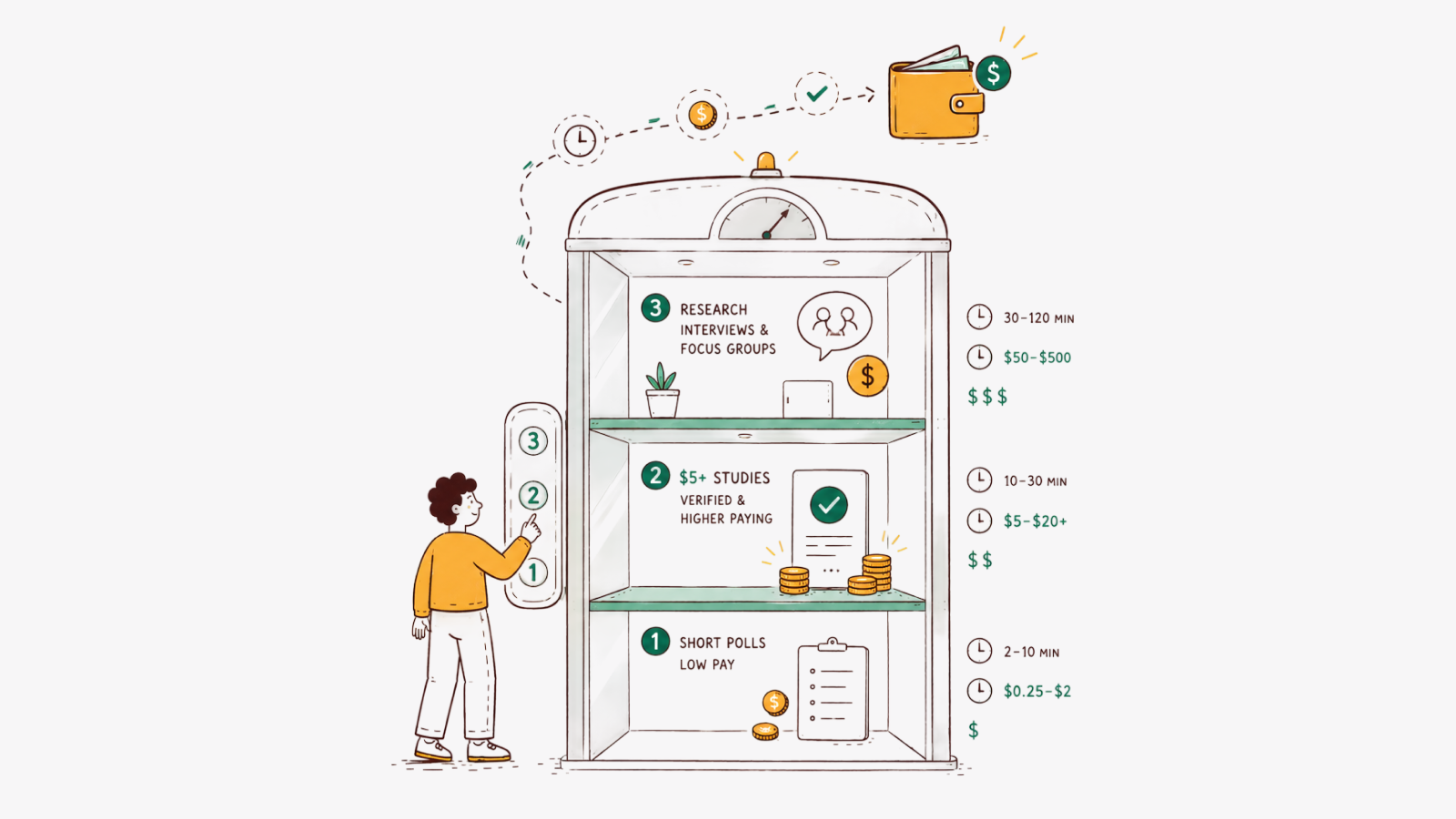
A genuinely high-paying survey pays $5 or more per completion. Most standard surveys pay between $0.25 and $5 each, and the real money sits in research studies and focus groups that run from $50 to $500 a session.
Surveys and studies are a supplement to your income, not a replacement for a job. Anyone promising $900 an hour is selling a fantasy, so this guide shows you where the honest $5-plus work lives and how to tell it apart from the scams.
What counts as a high-paying survey?
A high-paying survey clears $5 per completion, or pays an effective rate at or above the research-panel floor of roughly $8 an hour, and that floor comes from real platform policy. Prolific, one of the largest academic research platforms, enforces a minimum of about $8 an hour and recommends researchers pay at least $12.
Standard opinion surveys rarely reach that bar. Most pay $0.25 to $5, cluster at the low end of that range, and take 10 to 20 minutes, which is why "high-paying" points you toward vetted studies rather than quick polls.
- Standard opinion surveys land between $0.25 and $5 per completion.
- High-paying work clears $5, or runs at $8 an hour and up.
What matters is your effective hourly rate, the payout divided by the time a survey takes. A cheaper survey can beat a pricier one once you count the minutes involved.
By that measure, a $2 survey finished in four minutes works out near $30 an hour, better than a $10 survey that drags on for 45 minutes at roughly $13 an hour.
How much can you really make?
Most people earn a few dollars a day from surveys, not a full-time income. Those who earn more stack research studies and focus groups on top of standard opinion surveys, where the higher rates start to add up.
The payout-to-time math
Your effective hourly rate is the only fair way to compare two surveys. A $1 survey that eats 10 minutes works out to about $6 an hour, while a $5 survey done in 15 minutes runs closer to $20 an hour, so the higher sticker price doesn't always win.
Real-world totals land below the best-case rate. One independent tester logged 87 hours across 15 survey sites over three months and earned $1,247, an average of about $14.33 an hour.
Treat every figure here as an estimate. Your rate shifts with your demographics, the panels you qualify for, and how many surveys you finish without a screen-out.
| Survey value | Time to finish | Effective hourly rate |
|---|---|---|
| $1 | 10 min | about $6/hr |
| $2 | 4 min | about $30/hr |
| $5 | 15 min | about $20/hr |
| $10 | 45 min | about $13/hr |
Can you make $100 a day or $1,000 a month?
Standard surveys alone won't get you there. Swagbucks tells its own members to expect an extra $50 to $250 per month from steady survey-taking, which works out to a few dollars a day.
Reaching $100 in a day means changing what you do rather than doing more of the same. That kind of money comes from paid focus groups and research studies, where online sessions commonly pay $50 to $150 an hour.
A $1,000 month is possible only when you land several of those sessions and treat surveys as the filler between them. On standard polls alone, you won't get close.
- Standard surveys, worked steadily, cover the first $50 to $250 of a month.
- One or two focus groups a month can double that on their own.
- Stacking both is what pushes a strong month toward that $1,000 ceiling.
Why "$900 an hour" claims are a red flag
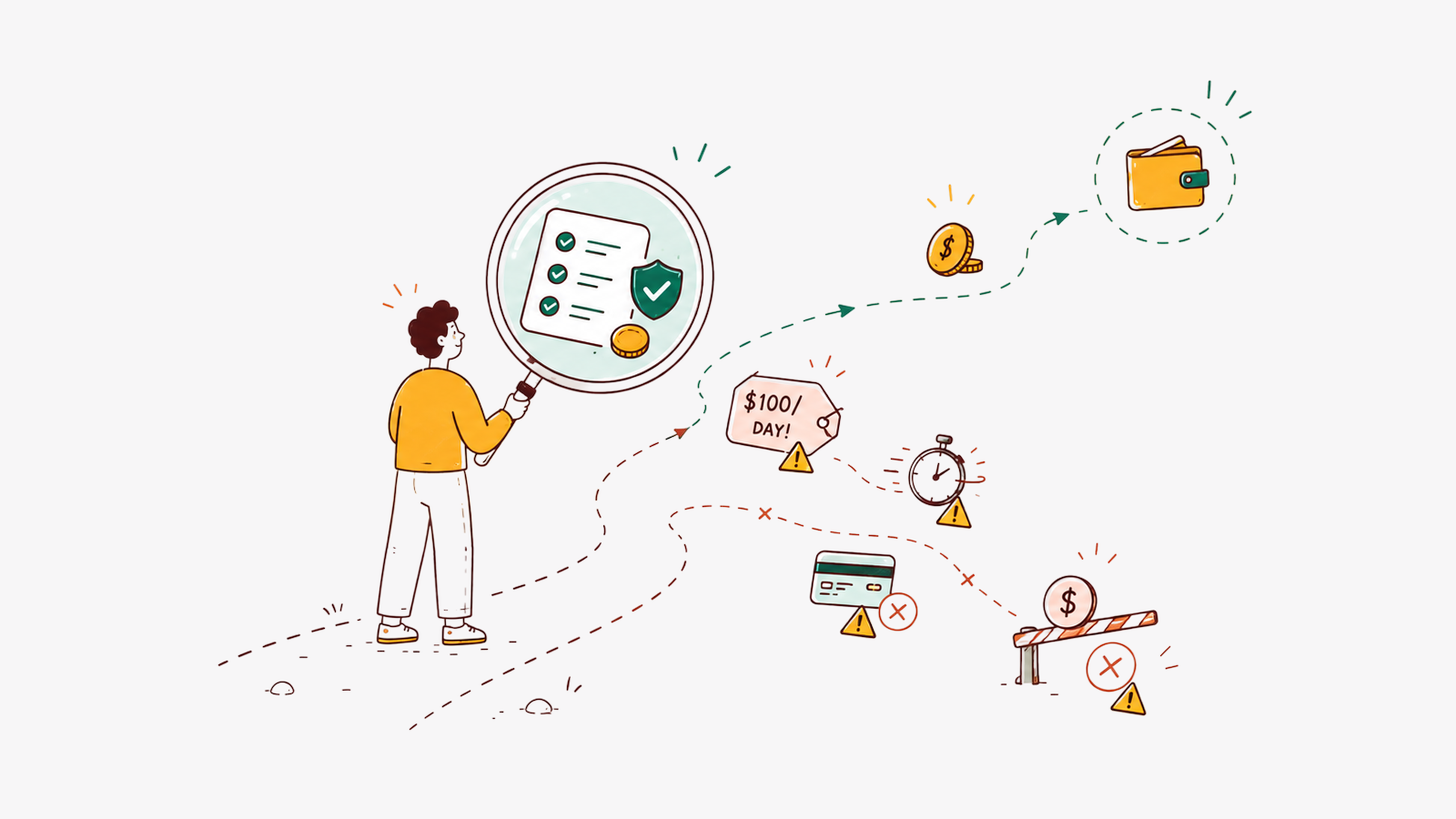
Any survey promising hundreds of dollars an hour is either an ad for something else or an outright scam. Real panels top out far lower, with vetted research floors near $8 an hour, nowhere close to $900.
Those viral "$900 an hour" and "$1,000 a day" headlines lead to offer walls, app downloads, or sign-up funnels that pay a fraction of the title. InboxDollars, one of the longest-running panels, puts it plainly: only scammers promise huge gift cards or high-paying jobs for survey work.
Use the size of the promise as a filter. Panels that pay honestly advertise a few dollars per survey, so a headline salary is your cue to close the tab.
The highest-paying survey types, ranked
The highest-paying survey work is barely surveys in the usual sense. Paid research studies and focus groups pay the most, while standard opinion surveys sit at the bottom of the range.
Standard panels show the floor clearly. Swagbucks and InboxDollars both put typical surveys at $0.25 to $5, with occasional outliers above $20 on Swagbucks. On Survey Junkie, regular surveys pay $0.20 to $4.00 per DollarSprout's testing, though its focus groups pay $25 to $150 a session.
Focus groups and interviews are the true high-payers. Sessions commonly run $50 to $300, and specialized panels reach $500.
| Survey type | Typical pay | Time or format |
|---|---|---|
| Standard opinion surveys | $0.25 to $5 | 5 to 30 min |
| Vetted research studies (such as Prolific) | $8/hr minimum, $12/hr recommended | varies by study |
| Focus groups and interviews | $50 to $500 per session | 30 min to 2 hours |
Those rates trace back to real budgets. The global market-research industry generated almost $54 billion in 2023, which is why a 90-minute focus group pays what dozens of quick polls would.
Are high-paying surveys legit?
Legitimate high-paying surveys and research panels exist, and they pay real money.
The catch is a crowded field of scams. The skill worth learning is telling a real payout from a trap, which comes down to spotting the warning signs of a scam and understanding how an honest payout works.
How to spot a survey scam
A legitimate survey site never charges a fee to join and never asks for your bank login or Social Security number. The major panels say so themselves, and it holds across the industry: legitimate surveys are always free, and you should never have to pay money to make money.
Scam sites share a handful of tells worth memorizing.
- Payouts that sound too good to be true, like headline salaries or thousand-dollar gift cards.
- Upfront fees to unlock or claim a reward, a classic scam tell.
- Urgent "act now" language built to rush you.
- Requests for banking logins, your SSN, or other sensitive data.
If a site asks for money upfront or for sensitive financial details, walk away, then report it at reportfraud.ftc.gov.
Legitimate panels earn from the researchers who buy the answers, so joining costs you nothing. Any survey that wants payment to unlock rewards has the model backward.
How real payouts and cash-outs work
Real payouts are the points or cash you redeem once your balance clears a site's rules, and thresholds vary widely by panel.
Survey Junkie is a clear example, where one point equals one cent and the minimum cash-out is 500 points ($5), withdrawable to PayPal, your bank, or gift cards. InboxDollars sets a higher bar with a $15 first cash-out before later withdrawals drop to $10 and up.
Some apps skip the points system and pay cash directly. TopSurveys pays real cash rather than points, with a $5 minimum, instant withdrawals, and no fee, and you can check how TopSurveys handles payouts before you sign up anywhere.
Getting paid fast with instant and PayPal payouts
The fastest cash-outs come from sites with a low minimum and either PayPal or instant withdrawal. When you compare panels for speed, weigh the balance you must reach before cashing out against how quickly the money lands.
A low minimum gets you paid sooner. Survey Junkie lets you withdraw at $5 with no fee, while InboxDollars makes you reach $15 for a first cash-out, which can mean weeks of extra surveys before you see anything.
Processing speed is the other half. InboxDollars batches payments every Wednesday, and Swagbucks says a first payment can take a week, with later requests often clearing in one to two business days. Instant withdrawal beats both.
| Panel | Minimum cash-out | Payout speed |
|---|---|---|
| Survey Junkie | $5 | on request via PayPal, bank, or gift cards |
| InboxDollars | $15 first cash-out, then $10+ | batch processed every Wednesday |
| Swagbucks | varies by reward | about a week at first, then 1 to 2 business days |
| TopSurveys | $5 | instant via PayPal, bank, or gift cards |
TopSurveys fits that fast-payout profile, with real cash rewards, a $5 minimum, and instant withdrawals. You can start a survey and cash out as soon as you've earned.
Why you get screened out, and how to qualify for more
You get screened out when you don't match a study's target demographic or when its quota is already full. It's a normal part of how research panels work rather than a glitch or a penalty.
Researchers need specific people, say dog owners aged 25 to 34 in a certain region, and once they have enough of them the study closes to everyone else. The qualifying questions at the start exist to sort you in or out fast.
You can reduce screen-outs and reach more studies with a few habits.
- Keep every profile and demographic survey a panel offers complete and current, so it can match you to more studies.
- Answer honestly and consistently, since contradictory responses flag your account and end the survey.
- Respond promptly when invitations arrive, because quotas fill quickly.
- Join several panels so more studies reach you in the first place.
- Watch your response speed, since rushing through questions can trigger the quality checks that end a survey early.

How to start earning with high-paying surveys
The practical path is to join two or three legitimate panels, prioritize research studies and focus groups for the higher rates, and favor sites that pay out fast. That combination gives you more invitations, better pay per hour, and money you can actually withdraw.
Keep your expectations realistic, because even a strong month of studies and sessions is pocket money next to a paycheck.
For the fast-payout end of that pairing, TopSurveys pays real cash with a $5 minimum and instant withdrawals, and it works well alongside a research panel like Prolific for the higher-paying studies.