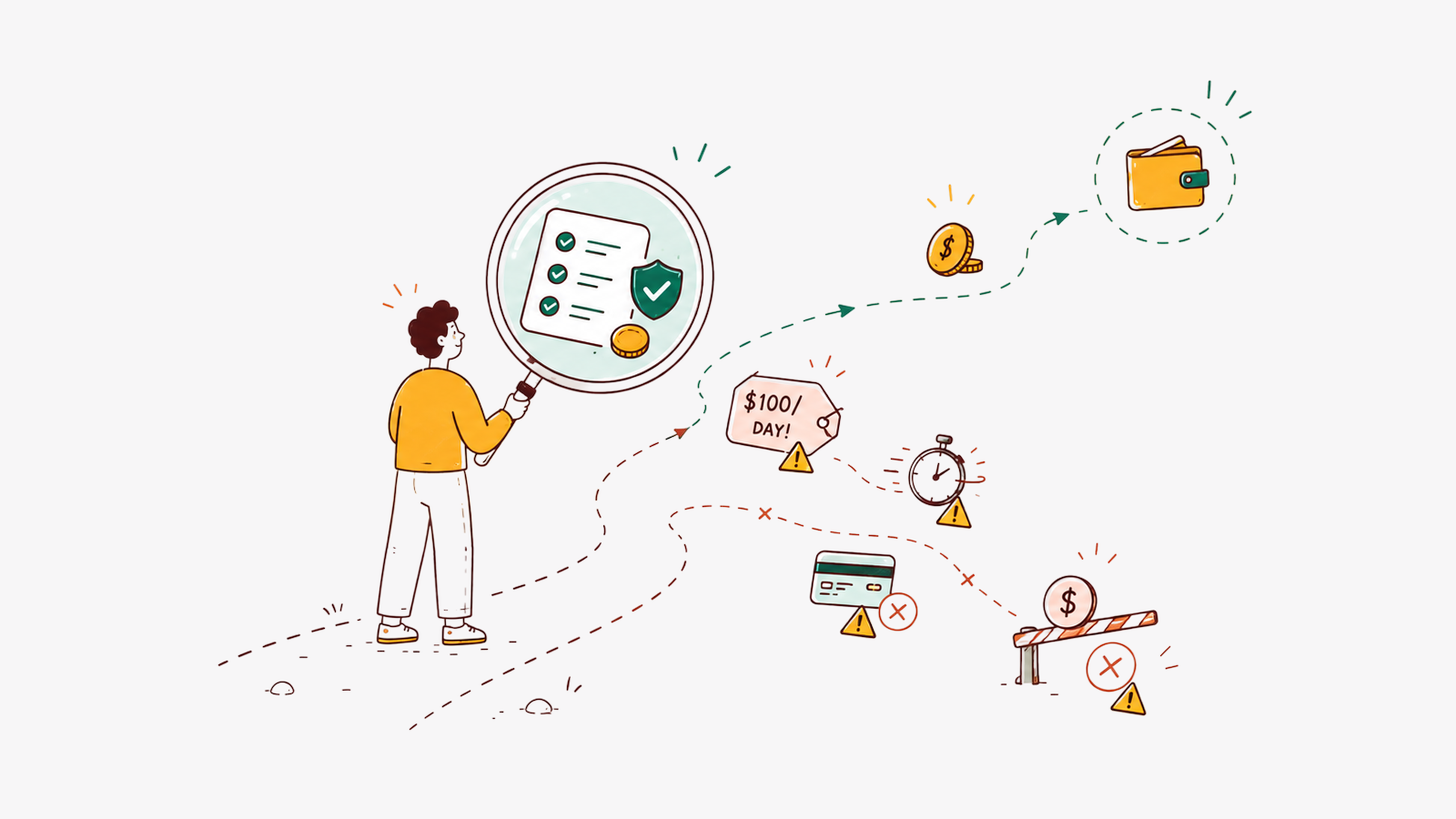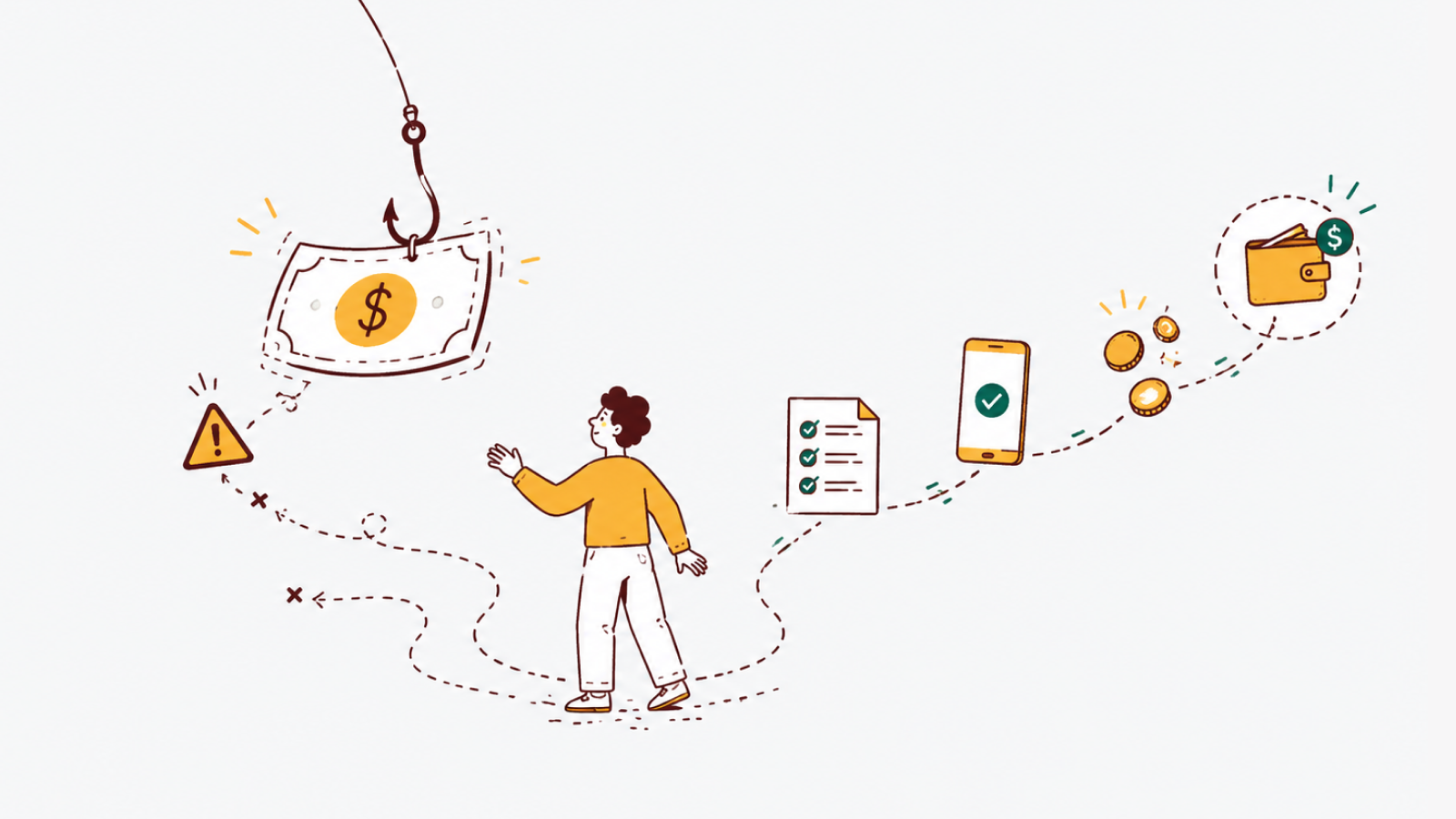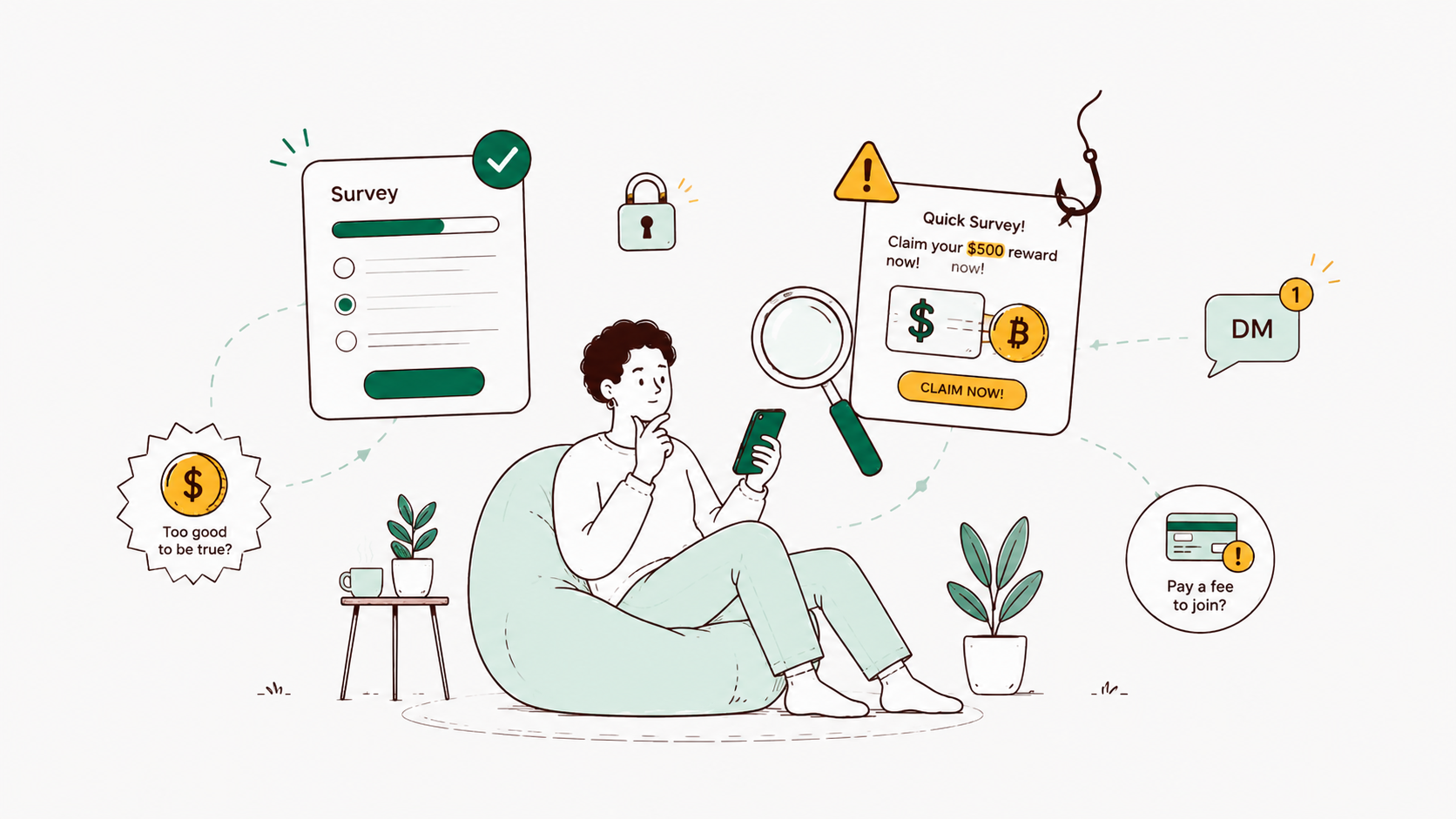
A survey scam is a fake survey, site, or app that poses as a paid-research offer so it can take more money or data from you than it ever pays out. Real paid surveys exist and pay modest amounts for your opinions, which is exactly why scammers copy their look so closely.
The losses are large and rising. US consumers reported losing more than $12.5 billion to fraud in 2024, a 25% increase over the prior year, and the share of fraud reporters who lost money climbed from 27% to 38%.
Most survey scams run a single playbook. The fake offer earns your trust with a small reward or a big promise before it pivots to a fee, a deposit, or a data grab; the nine flags below help you catch that pivot early, before it costs you.
Red flag 1: it asks you to pay to get paid
Any site that charges a joining fee, a withdrawal fee, or a deposit to unlock better-paying tasks is a scam. A real survey app only ever sends money to you, and it never asks you to pay in first.
Never pay anyone to get paid, because no honest company works that way. Being told to send cash to release earnings you supposedly made is one of the clearest fraud signals there is.
A common version asks for a small activation or processing fee before your first payout, money you never see again. Reported job-scam losses topped $220 million in the first six months of 2024, per the FTC's task-scam data, and task scams made up nearly 40% of 2024 job-scam reports.
Red flag 2: it demands gift cards, crypto, or a wire transfer
A real reward never requires you to pay in first with gift cards, cryptocurrency, or a bank wire. That demand is a scam on its own, no matter how carefully the message is worded.
Any gift-card payment demand is a scam, with no exceptions, because gift cards are meant for gifts and not for payments. Roughly one in four people who reported a fraud loss to the FTC said it happened when they handed over the numbers on a gift card.
Scammers push these channels because the money is almost impossible to trace once it's gone. In 2024, people reported losing more to scams paid by bank transfer or cryptocurrency than by every other payment method combined, in the FTC's fraud data.
Red flag 3: it asks for data a real survey never needs
No legitimate survey needs your Social Security number, bank login, full card number, or account passwords. If a form asks for any of those, close it.
A real app collects only what it needs to match you with relevant surveys, such as your age, country, and general demographics. Anything reaching past that basic profile is a warning sign, not a normal step.
Fake surveys have become a common way for scammers to phish for personal information. The details they're after are the exact ones that unlock your identity and your accounts, which is why the FTC treats a survey that asks for financial or personal information as a scam.
Red flag 4: the reward is way too big for the effort
A $100 gift card or a 90% discount for three quick questions is bait, not a reward. The math never works in your favor when the payout is wildly out of line with the effort.
The Better Business Bureau lists a too-good-to-be-true reward among the most dependable scam tells. Honest surveys pay small amounts that reflect a few minutes of your time, not a windfall for barely any work.
Scammers dangle the big number on purpose, since excitement short-circuits caution and gets you clicking. A genuine panel shows the reward and the expected survey length before you start, and the amounts line up.
Red flag 5: you can't tell who runs it or why
A real survey states the brand behind it, what data it collects, and why it wants that data. An anonymous survey with no named operator and no privacy policy fails that test.
Real surveys are direct about the brand involved, the information requested, and how it gets used, per the BBB's fake-survey guidance. When you can't tell who's asking or what they plan to do with your answers, treat the survey as unsafe.
Missing contact details, a blank "about" page, or a privacy policy that never loads all point in the same direction. A legitimate operator wants you to know who they are, and a quick search for the company name confirms whether a real business stands behind it.
Red flag 6: you "won" a prize but must pay to claim it
If you have to pay a fee, taxes, or shipping to collect a prize you supposedly won, it's a scam. Real prizes are free.
The pitch banks on the win feeling real, telling you a reward is already yours and only a small payment stands between you and the money. Once you pay, the prize never arrives and the scammer moves on to the next target.
A slicker version asks for your card details to "verify" the win, which hands over both your money and your data. Genuine sweepstakes don't charge you to release winnings, and they don't rush you into paying before you can check the details.
Red flag 7: it pays you to like, rate, or review things
Being paid to like, rate, or post reviews isn't survey work. The FTC calls it illegal outright, and no honest company will do it.
These offers are a classic task-scam pattern, and the volume has exploded. Reports of task-based online job scams grew from zero in 2020 to 5,000 in 2023, then to about 20,000 in the first half of 2024, FTC figures show, tracking the flood of "easy online task" gigs in DMs and ads.
The money at stake goes well beyond a few missed survey rewards. Employment scams were the No. 2 scam type in 2024, carrying a $1,500 median loss.
Red flag 8: it found you first through a DM, text, or social ad
A survey offer that lands unsolicited in a DM, a text, or a social ad, especially one pushing you to act fast, is far more likely to be a scam than a real research invite. Legitimate research panels don't chase you through cold messages.
Almost 50% of scams that started on social media began when someone responded to an ad or a post, BBB's Scam Tracker data shows. The risk lands hardest on younger earners: employment scams rank as the No. 1 riskiest type for ages 18 to 34.
The pull is flexible, work-from-home cash, which BBB's research found is the top factor drawing people in. Reports of job and employment agency scams tripled between 2020 and 2024, with losses rising from $90 million to $501 million in the FTC's data.
Red flag 9: it pays you once, then charges you to unlock more
This drip scam works precisely because the first payout is real. A small amount lands in your account for an early task or survey, which proves the gig "pays" and lowers your guard before you're asked for a single dollar.
Then the direction reverses. To reach the next earning tier, clear a "premium" batch, or release the larger balance you have supposedly earned, you are told to deposit your own money first, and each level you unlock demands more than the last.
That escalation is the tell that separates this from flag one, where the fee lands before you have earned a cent. Here a real payout wins your trust first and the charges start after, so once an app flips from paying you to billing you, walk away before the deposits climb and the money is lost for good.
How to verify a survey app is legit before you sign up
You can clear most survey apps in under five minutes with a quick pre-signup check. A short scan of who runs the app and how it pays tells you almost everything you need.
- Search the company name alongside "scam" or "reviews", and read what real users report about getting paid.
- Open the privacy policy and skim what data the app collects and whether it sells that data.
- Confirm who operates the app and how support works, looking for email plus a help center rather than big promises and no way to reach anyone.
- Check the app-store listing, its rating, and how recent the reviews are.
- Get the cash-out terms in writing before you earn a cent, including a real minimum and real payout methods.
Legit operators are upfront about who they are and what they collect and use. If an app dodges those questions, you already have your answer.
A real app will still be there in 10 minutes, and any pressure to skip these checks is itself a warning sign.
What to do if you've already been scammed
Act fast. The sooner you report the scam and lock down your accounts, the more of the damage you can limit.
- Report the scam at ReportFraud.ftc.gov so investigators can track the operation behind it.
- Call your bank or card issuer to stop or reverse the payment while it's still pending.
- Change the password on any account you exposed, and switch on two-factor authentication.
- Place a free credit freeze or fraud alert with the credit bureaus if you shared your Social Security number.
- Save every screenshot, message, and receipt, since a paper trail makes your report far stronger.
None of these steps guarantee a refund, but each one closes a door the scammer was counting on staying open. Card and bank payments are the most time-sensitive, so make that call before the transaction clears.
Keep copies of everything even after you file, since your bank and the credit bureaus may ask for the details later.
How a legitimate survey app actually works
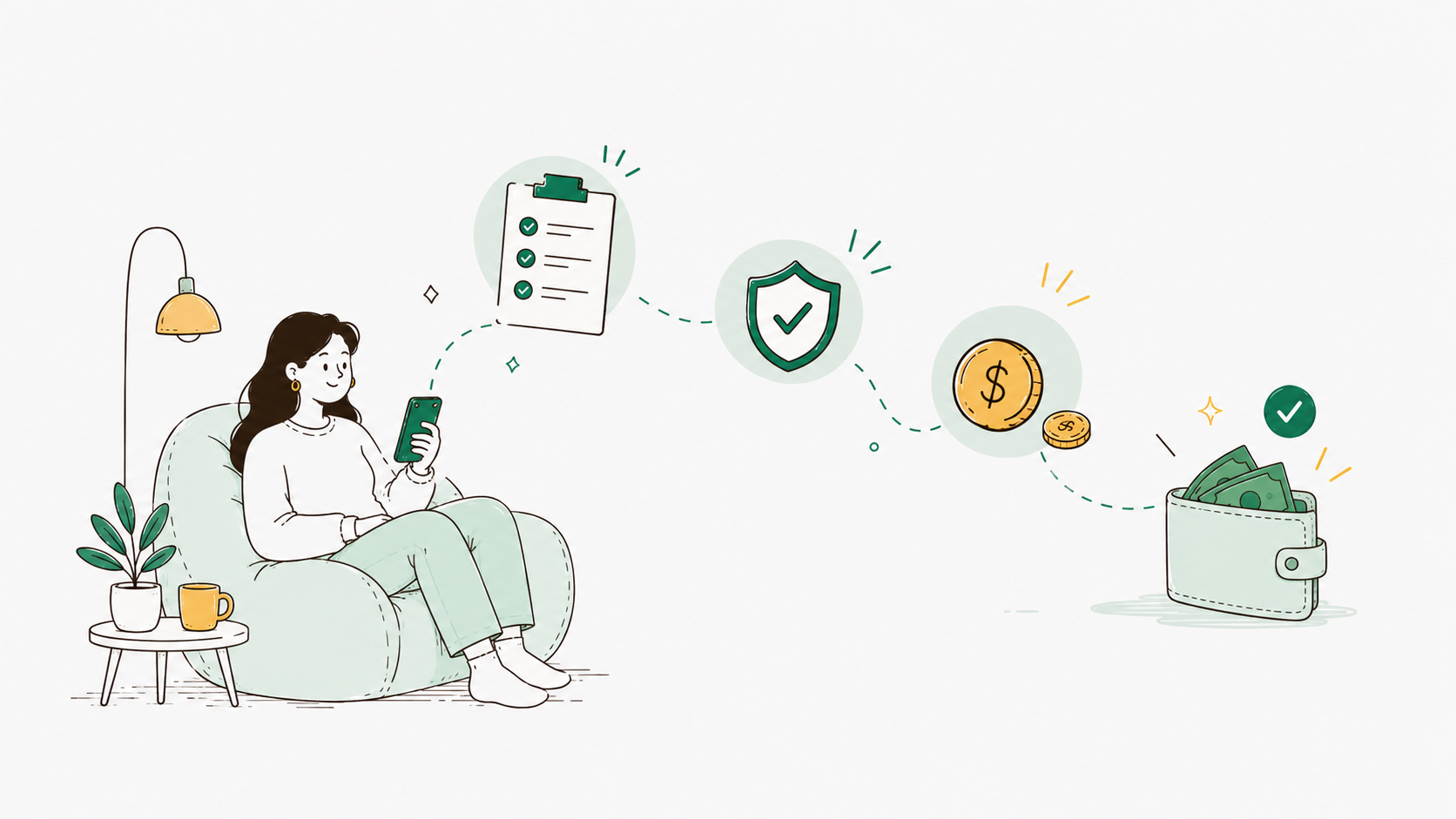
A legitimate survey app is the mirror image of every flag above. It pays you real money, sets a low and clearly stated cash-out bar, and never charges you to join or to withdraw.
| What to check | A scam | A legitimate app |
|---|---|---|
| Payment direction | Asks you to pay in | Only ever pays out to you |
| Cash-out minimum | Hidden, moving, or "unlockable" | Low and stated up front, such as $5 |
| Data requested | SSN, bank login, full card number | Email and basic demographics |
| Operator | Anonymous, no policy | Named company with a privacy policy |
| Support | Vanishes after you pay | Email, help center, and FAQ |
| Reward type | Vague points you can't redeem | Real cash you can withdraw |
TopSurveys is one app built around those checks. It pays real cash in multiple currencies rather than points, and it sets a $5 minimum cash-out with instant PayPal withdrawals, subject to routine confirmation checks.
The app is free to use, so you never pay to participate, and support runs through email plus a help center, FAQ, and in-app announcements.
A fair survey app also handles the misses, crediting a small payout when a survey screens you out partway through, so your time isn't wasted.
How to spot the next scam and earn safely
The nine flags work as a single filter you can reuse on any survey offer. Run the quick pre-signup check, and treat any app that asks you to pay, hides who runs it, or dangles an outsized reward as a hard no.
Legitimate survey earning is steady and modest, not a windfall. Stick with apps that pay real cash and state their cash-out terms in plain sight.
Once an app clears every flag, the only thing left is to answer a few questions and build toward your first cash-out. Keep the pre-signup check handy for the next "earn fast" offer that lands in your feed.