
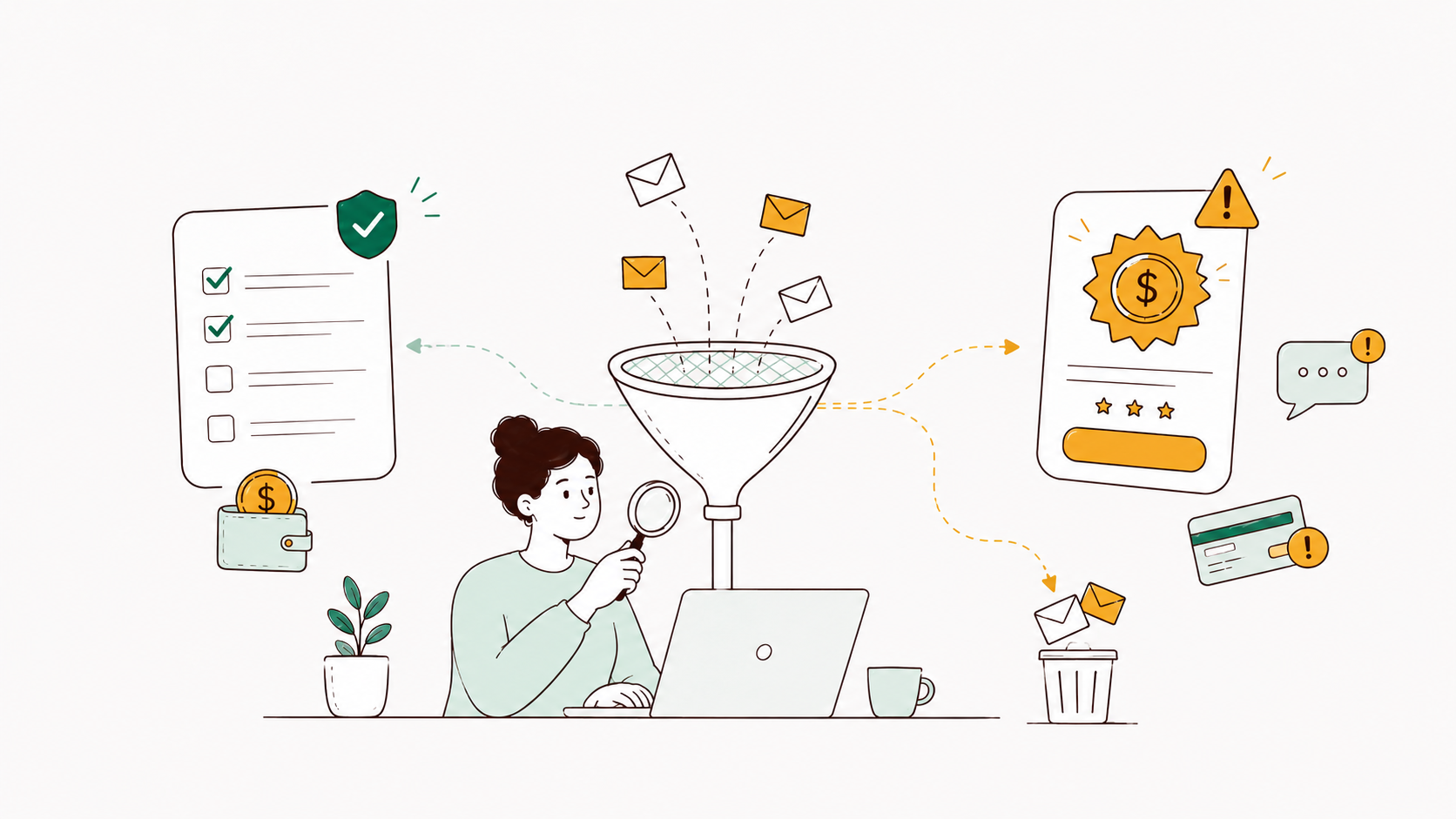
An online survey scam is a fake survey or "survey job" that dangles a prize or easy cash to take your money or your personal data. A real survey never asks you to pay to join, deposit money to earn, or hand over your Social Security number, bank login, or card details.
Survey scams are real and common, and they wear the same clothes as the legitimate apps they impersonate.
This guide covers the red flags, the formats making the rounds in 2026, how to check an app before you sign up, and what to do if you've already been caught out.
What online survey scams are and how they work
Most survey scams run the same short playbook, and they lean on people hunting a side hustle for a reason. Learn the mechanic once and the red flags later become obvious.
How a survey scam plays out
An unsolicited offer lands by text, call, email, or ad, promising a prize or guaranteed pay for a few minutes of your time. From there the scam splits two ways.
One version asks for money first, requesting a "processing fee," "taxes," or "shipping" to release a prize that never arrives. The other skips the fee and goes straight for your details, using the questionnaire as cover to collect personal and financial information.
Either way, the bait is always something worth chasing. The lures come in a few standard shapes.
- A cash prize or gift card you never entered to win.
- A "free" gadget such as a phone or tablet.
- A sweepstakes entry, or a per-survey rate far above the norm.
Why scammers target side-hustle seekers
Side-hustle seekers are actively looking to earn, so a "get paid to take surveys" pitch lands with them in a way it wouldn't with someone who isn't shopping for extra income.
The scale is hard to ignore. The FBI's Internet Crime Complaint Center logged $16.6 billion in reported losses in 2024, up 33% from the year before, and job scams have grown even faster.
Reported losses to job scams topped $220 million in just the first half of 2024, having more than tripled from 2020 to 2023, which is why a survey "job" that sounds effortless deserves a second look.
The most common online survey scams to avoid in 2026
Four formats keep resurfacing, from fake-prize fees to gamified "survey jobs" that pocket your deposit. Each one has a tell you can learn in a single sentence.
Upfront-fee and fake-prize scams
You "win," then you're asked to pay before you can claim. That fee, dressed up as processing, taxes, or shipping, is the whole scam, and the prize doesn't exist.
The modern twist is the gift card, where the scammer tells you to buy cards and read back the numbers instead of sending a wire. That's untraceable once shared, and about a quarter of the people asked to pay a fake fee this way bought the cards and lost an average of $200.
No genuine prize needs a payment to release it. If money has to leave your account before a reward arrives, walk away.
Fake-check and overpayment scams
A scammer sends a check that looks real, tells you to deposit it, then asks you to wire part of it back or forward it to a "vendor." Days later the check bounces and the bank claws back the full amount.
The check carries a familiar brand name to lower your guard. SurveyMonkey states plainly that it does not issue checks to pay people, and that a coupon bearing its logo but redeemable elsewhere is a scam.
A real reward never arrives as a check you have to partly send back. Any "overpayment" you're asked to return is the tell.
Data-harvesting and phishing surveys
Some "surveys" want nothing but your data. There's no prize and no payout, just a form built to collect enough about you to commit fraud.
These reach you cold. Scammers send fake surveys through spam texts, calls, and emails, touting products and rewards to harvest sensitive information.
The stolen details feed identity fraud and a second wave of phishing aimed at the accounts you just exposed. A survey that asks for your date of birth, SSN, or account logins is building a profile for fraud, not collecting opinions.
Pay-to-play "survey job" and task scams
If a "survey job" asks you to deposit your own money to unlock more tasks or bigger payouts, it's a scam. Real work pays you and never asks you to pay first.
These gamified task scams grew fast. About 20,000 people reported them in the first half of 2024, up from roughly 5,000 in all of 2023, and they made up nearly 40% of job-scam reports in the FTC's data. Cryptocurrency losses to job scams reached about $41 million in the same period.
The mechanic is built to feel like real work. You finish a few small tasks, watch a balance climb, then get told to put your own money in to "unlock" the next set, and that money is lost the moment you send it.
Red flags that a survey is a scam
The clearest single tell is money moving the wrong way. If a survey or survey "job" asks you to pay, deposit, or buy anything to take part or to cash out, it's a scam, full stop.
The rest of the warning signs cluster around pressure and data. Watch for these.
- An upfront fee or a deposit to "unlock" earnings or a prize.
- Guaranteed pay, or a per-survey rate far above the going rate.
- Requests for your SSN, bank login, card number, or an account password.
- Unsolicited contact, a cold text, call, or email, promising a reward.
- A check you're told to deposit and then partly wire back.
- No privacy policy, and no explanation of how your data gets used.
- A free-webmail sender or a lookalike domain instead of a real company address.
- Pressure to act right now before the "offer" expires.
A legitimate survey never asks for a Social Security number, bank or card details, or a password, and a real site publishes a privacy policy. For a fuller list, see our 9 red flags of a survey scam.
How to check a survey site or app is legit before you sign up
Before you sign up, run a short check, and if the offer fails any item, close the tab. The whole thing takes about a minute.
Work through these before you hand over anything.
- A privacy policy is published, and it says how your data gets used.
- Joining never requires your SSN, bank login, or password.
- There's no fee or deposit to take part or to cash out.
- The app has an official App Store or Google Play listing under a consistent name.
- Contact comes from a real company domain, not a free Gmail or Yahoo address.
- Independent reviews and a payout track record exist that you can find yourself.
Cross-check the app's own claims against what other users report about getting paid. If you're still weighing whether online surveys are actually legit, a companion guide answers that in full.
An app that clears every item here looks nothing like the scams above. TopSurveys, for example, publishes a privacy policy, never charges to join or cash out, and runs from its own company domain rather than a cold email address.
What to do if you've already given a scammer your details
Act fast, because the first few hours decide how much damage a scammer can do. Work down this list in order.
- Stop all contact and send no more money, whatever you're threatened with.
- If you paid by gift card, keep the card and the receipt, then call the card issuer's fraud line right away.
- Contact your bank or card company about any payment you made or any check you deposited.
- Change the password on every account you exposed, and turn on two-factor authentication.
- Report the scam to the FTC, and if your identity was taken, start a formal recovery plan.
- Watch your accounts closely, and consider a credit freeze to block new accounts opened in your name.
Gift cards are a scammer's favorite because they're hard to reverse, so speed matters most there. Keeping the card and receipt gives the issuer something to work with.
None of this guarantees a full recovery, but acting inside those first hours limits what a scammer can take.
How a trustworthy survey app actually works
A real survey app looks nothing like the formats above. It's free at every step, from signing up to cashing out, and upfront about exactly how its rewards and withdrawal terms work.
What a legitimate survey app never does
A legitimate survey app never charges you to join, never asks you to deposit to earn, and never needs your SSN or bank password. Those three lines rule out most scams on their own.
The same holds for any real work, where you get paid to do a job rather than paying for the chance to start one.
Read the red flags in reverse and you have a quick trust checklist.
- It's free to join and free to cash out above a low, published minimum.
- Rewards are real and spendable, with clear withdrawal terms.
- The only details it asks for are the ones a payout needs, like a PayPal email.
- It runs from an official app listing and a real company domain.
An app that clears all four is safe to try. One that trips any of them isn't worth your time, no matter how good the advertised rate looks.
What real survey rewards look like
Real rewards are modest but genuine, small cash and gift-card payouts you can actually withdraw, not the life-changing figures a scam advertises. An honest app is clear about that ceiling up front, so the number you see is the number you get.
TopSurveys is a straightforward example of the legitimate model. It pays real cash for surveys rather than points, sets a $5 minimum cash-out, processes instant withdrawals subject to fraud checks, and never asks you to pay to take part.
Honest apps make those terms clear before you start. It's worth reading up on what paid surveys really pay and surveys that pay out instantly, plus the legit ways to get free gift cards and how earning gift cards through legitimate surveys actually works.
Your next survey, without the guesswork
The one-line test carries most of the weight. An offer that asks you to pay in, or reaches for data a survey has no business collecting, is done before you start.
Everything else is a quick habit. Run the minute-long check on any new app, favor the ones with a payout track record you can verify, and treat unsolicited "you've won" messages as noise rather than luck.
A scam is the only kind of survey that promises a windfall, so keeping the one-line test in mind lets you earn a little spare cash without handing a stranger your money or your identity.