Paid surveys for college students can turn spare time into small amounts of real cash. The pay is modest, closer to pocket money than a paycheck, but there are no upfront costs and no set schedule.
On TopSurveys you cash out from $5 through PayPal, which means your first payday is well within reach.
This guide walks through how surveys work, what students realistically earn, and why they suit a packed class schedule. You'll also see how to cash out, how to spot the scam apps that target students, and the extra ways to earn once your account is set up.
How do paid surveys work for students?
You sign up for free, add a short profile, then get matched to surveys that fit your background and earn cash for each one you finish. Brands pay market research companies for opinions from specific groups, and students are a group they study constantly.
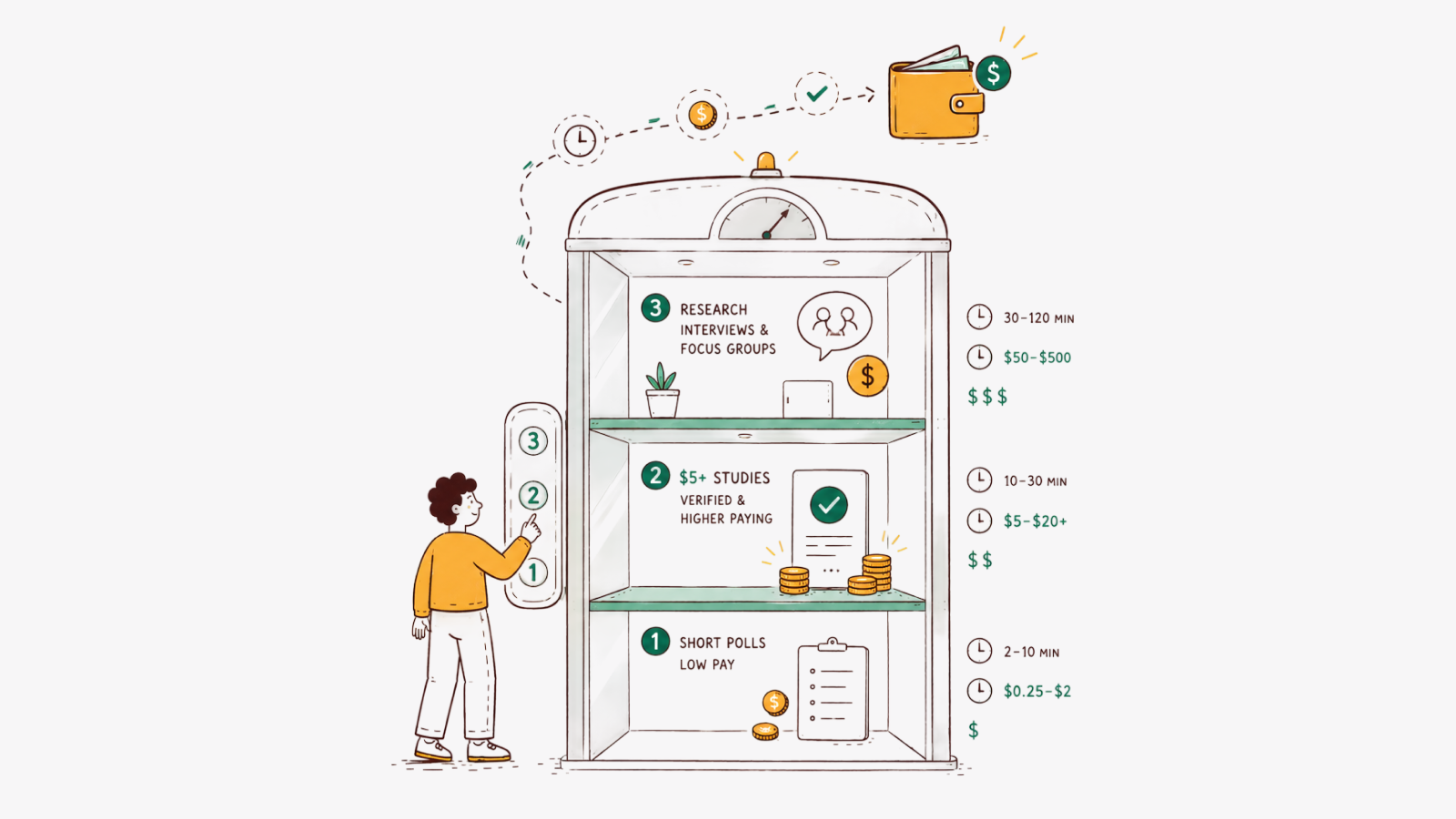
Most surveys pay around $0.50 to $3 and take 10 to 20 minutes, according to DollarSprout. Shorter surveys pay less, while the longer, more detailed ones pay more.
Getting started takes four steps:
- Create a free account with your email or a social login.
- Add a handful of profile details so the app can match you well.
- Open surveys from your dashboard on your phone or laptop.
- Cash out your balance as real money once you hit the payout minimum.
How much you earn depends on how well you match. Some surveys open with a couple of screening questions, and a mismatch means a screenout.
That's normal. On TopSurveys a screenout still pays a small amount plus a random reward.
You can see how the surveys work before you sign up. Once you're in, your dashboard sorts your best matches, shortest surveys, and highest-paying options up front.
Why surveys fit a college schedule
Close to half of college students hold a job alongside their studies. The Bureau of Labor Statistics puts the figure at 44.3% as of October 2023, and among part-time students it jumps to 77.7%.
The problem with most student jobs is the clock. Fixed shifts collide with lectures, group projects, and exam weeks, while a commute eats time you don't have.
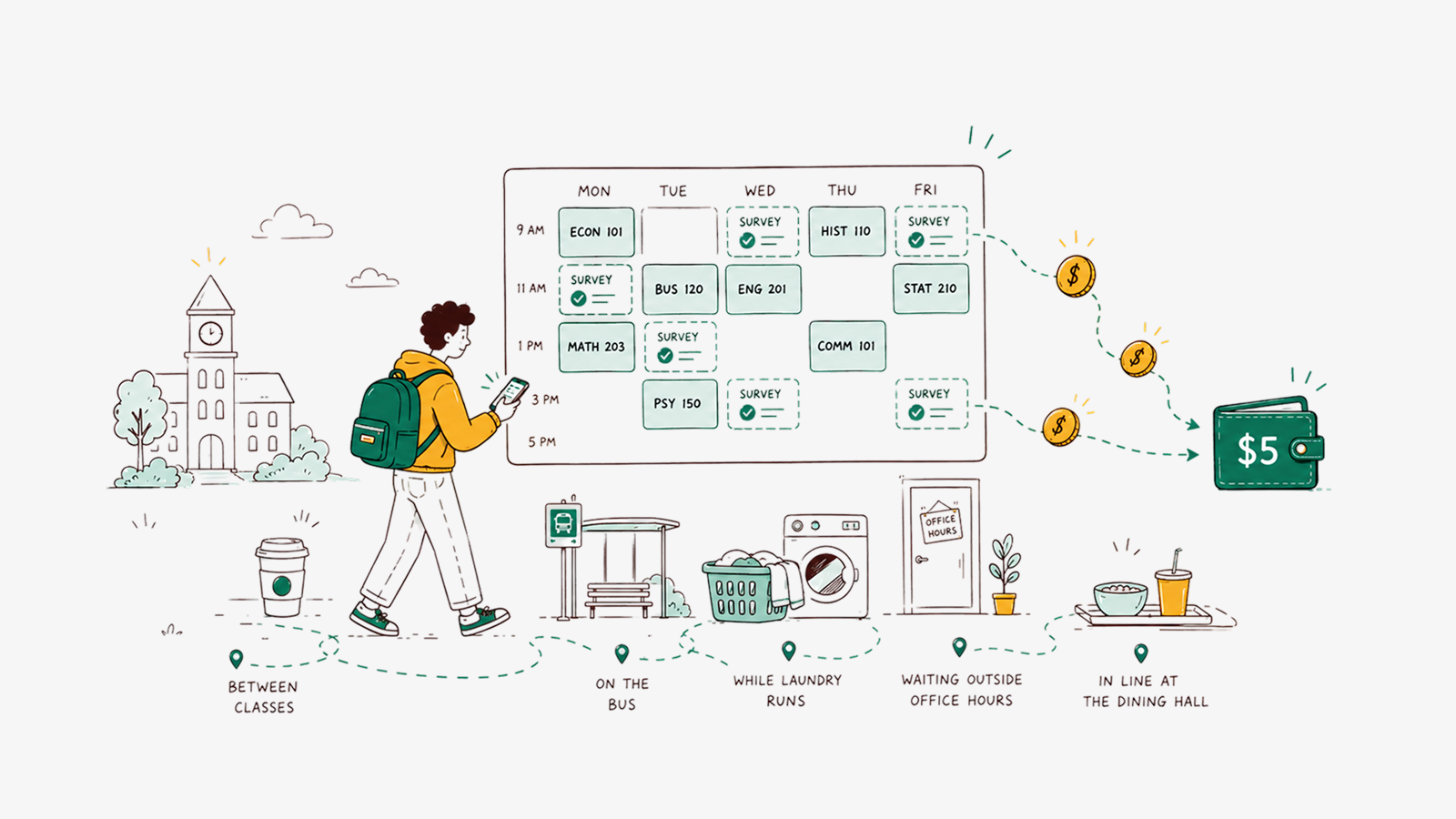
Surveys work differently because there's nothing to show up to. You pick them up in the gaps that already exist in your day:
- Between back-to-back classes
- On the bus or train
- While a load of laundry runs
- Waiting outside office hours
- Standing in line at the dining hall
Everything runs on your phone, so a 10-minute wait becomes a completed survey instead of dead time. You stop when your next class starts and start again later, without asking a manager or swapping a shift.
How much can students realistically earn from surveys?
Most students earn pocket money from surveys rather than a full income. What you make in a month is shaped by how many surveys you qualify for and the hours you put in.
| Earning type | Typical range |
|---|---|
| Per survey | $0.50 to $3 |
| Per hour (effective) | $1 to $4 |
| Per month (steady, spare-time) | $30 to $100 |
| Focus group | $50 to $100 per hour |
Typical per-survey and hourly pay
A single survey pays $0.50 to $3, and effective hourly rates land around $1 to $4 across platforms, DollarBreak's testing found. Screenouts and reading time are why the hourly rate lands lower than the survey pay alone suggests, and your profile drives how often you qualify.
Students match plenty of consumer and campus-life topics that brands pay to study, so you'll qualify for more surveys than people in narrow niches. More qualifying surveys means more of your time spent earning instead of screening out.
What a realistic month looks like
Over a month of steady, spare-time use, that works out to $30 to $100, based on the same DollarBreak testing across major platforms.
Push harder and the ceiling rises, though the best-paying work is rarer. Focus group research can pay far more, around $50 to $100 per hour in The College Investor's experience, but those slots are limited and you still have to qualify.
Claims of $1,000 a month from standard surveys don't hold up. Hitting that would take far more qualifying surveys than any app has to hand out, which is why an honest month lands closer to $100 than $1,000.
Treat survey cash as a top-up for textbooks, coffee, or a night out, and the numbers make sense. Expect it to replace a part-time paycheck and you'll be let down.
How to cash out your survey earnings
With TopSurveys you cash out from $5 as PayPal cash, gift cards, or a bank transfer, and PayPal withdrawals are instant once your account clears standard fraud checks. A low minimum matters more than it sounds, because a high one can trap your earnings in an account you never quite empty.
Here's how the $5 bar compares to two well-known names:
| App | Cash-out minimum | Method |
|---|---|---|
| TopSurveys | $5 | PayPal (instant), gift cards, bank transfer |
| Swagbucks | $5 (PayPal), $1 (gift cards) | PayPal, gift cards |
| Survey Junkie | $5 (PayPal) | PayPal, gift cards, bank |
Swagbucks and Survey Junkie thresholds via FinanceBuzz, which tested both platforms.
The minimums look similar on paper, but both competitors run on points. You earn points (Swagbucks calls them SB), reach 500, then convert them to a $5 value and request the transfer.
TopSurveys skips that step by paying in real cash from the start, so your balance is spendable the moment it clears $5. When you request a PayPal payout, you confirm your PayPal email and pass a quick new-IP check before the money moves.
TopSurveys also adds a small cashback bonus to your first reward claim and to later withdrawals, which nudges your total up a little over time.
How to spot and avoid survey scams
A legitimate survey site is free to join and pays you for your time. A scam does the opposite by getting you to pay before you can earn or withdraw.
Students make a favorite target because they're short on cash and searching for flexible online income, and scam apps are built to look like the answer.
Red flags to walk away from
Consumers reported losing more than $220 million to job scams in just the first half of 2024, according to the FTC. Reports of gamified "task scams" drove the surge, quadrupling to around 20,000 in that period and making up an estimated 40% of the year's job-scam reports.
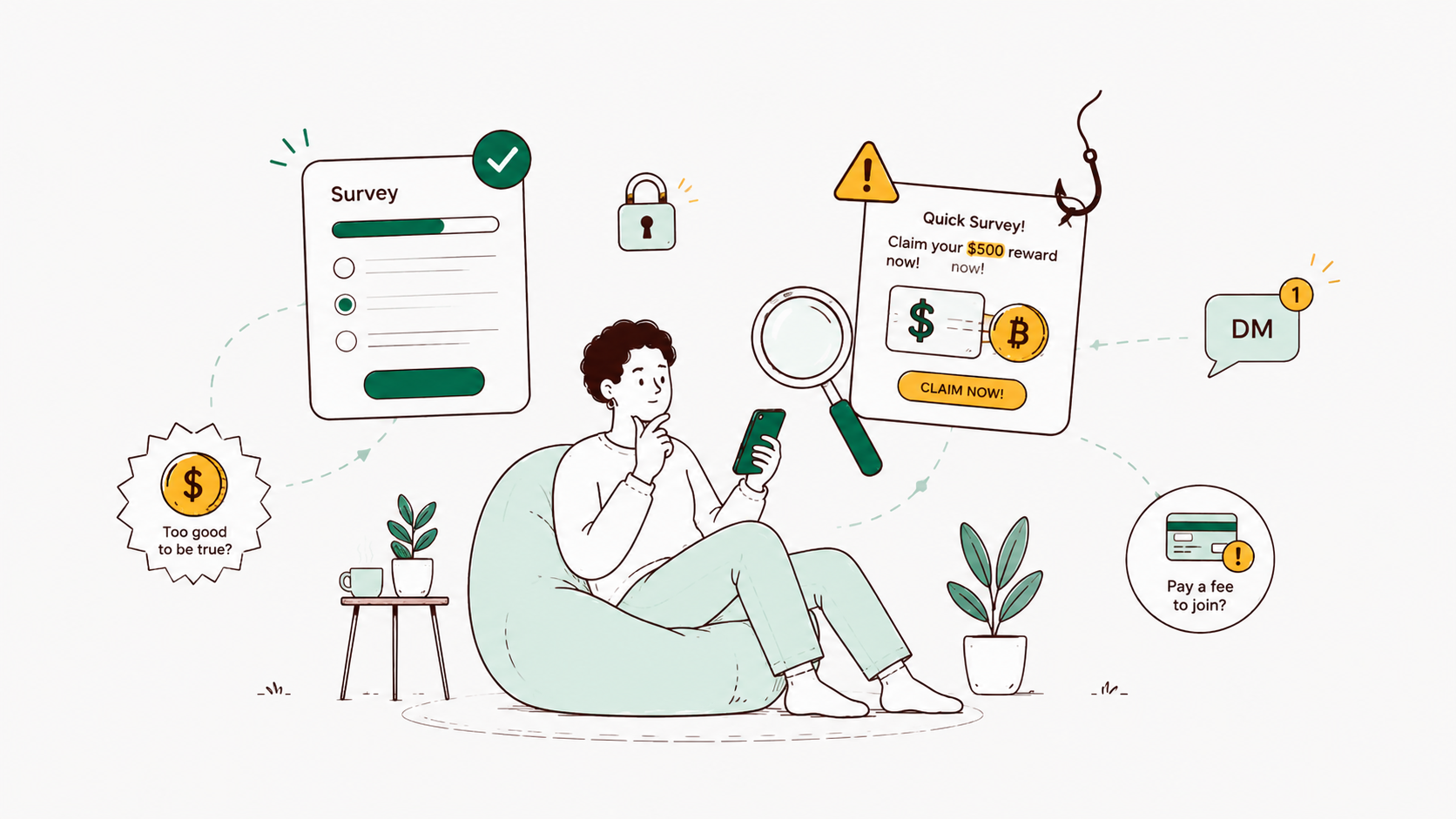
The scam follows a familiar pattern. A slick app shows your "earnings" climbing, pays you a small sum to build trust, then asks you to deposit your own money, usually in crypto, to unlock a withdrawal, the FTC warns.
Walk away when you see any of these:
- An upfront, "processing", or "verification" fee to start
- A request to deposit money, especially crypto, before you can withdraw
- Requests for your Social Security number, bank login, or card PIN
- Guaranteed income or a fixed daily payout
- Pressure to pay in or recruit others to earn
What a legit survey app never asks for
A legitimate survey company has you sign up with them directly and never needs sensitive financial details. It won't ask for your Social Security number, bank credentials, or PIN, or demand a purchase or fee to get started, Cash App's scam guidance explains.
Use that as your test. If an app wants money or bank access before you've earned a cent, close it.
TopSurveys passes that test on every point. It's free to join, takes no money to start, and makes no income promises.
You get paid for completing surveys, with withdrawals sent through PayPal after a standard email and new-IP confirmation.
Compare the two side by side and the difference is clear:
| Legit survey app | Scam "make money" app |
|---|---|
| Free to join | Charges a fee to start |
| Pays you for surveys | Asks you to deposit first |
| No sensitive financial info | Wants SSN, bank, or PIN |
| Honest, variable earnings | Guarantees big daily income |
Other ways students can earn on TopSurveys
Surveys are the core of TopSurveys, though a few other paths add to the same cash balance.
| Earning path | What it is | Effort |
|---|---|---|
| Game offers | Hit milestones in featured games | Higher, slower |
| Offer walls | Sign-ups, trials, and installs for one-off rewards | Varies |
| Referrals | Bonus plus 10% of a classmate's earnings | One-time setup |
Game offers
Game offers pay you to install a featured game and hit set milestones, like reaching a level or playing across several days. Payouts can beat a single survey, though they take longer and the effort varies by offer.
Read what each milestone requires before you start, since the time commitment should match the reward. This path suits downtime when you'd be gaming anyway.
Offer walls
Offer walls collect sign-ups, free trials, and app installs that pay a one-off reward, sometimes a bigger one than surveys or games. They're worth scanning when you want a larger single payout.
Check the terms on each offer, especially free trials that convert to paid subscriptions.
Cancel before the trial window closes and the reward is pure profit. Miss the deadline and the subscription charge can outweigh what you earned.
Referring classmates
Referrals reward you for bringing classmates on board. Share your personal link or code to earn a bonus plus 10% of what a friend makes once they join and start completing surveys.
Referrals fit a dorm or group chat where people already swap money-saving tips. That 10% comes from the company's side, not out of your friend's earnings, so it costs them nothing.
How to take your first survey today
Getting started takes only a few minutes. Make a free account, add a few profile details, and open the surveys that match you best.
Because there are no fixed hours, survey earning fits around a full course load, and everything you make is withdrawable from $5 through PayPal.
Pick one short survey between your next two classes and see how it feels. You can create a free TopSurveys account and take your first survey today, then decide if the between-class cash is worth your time.